
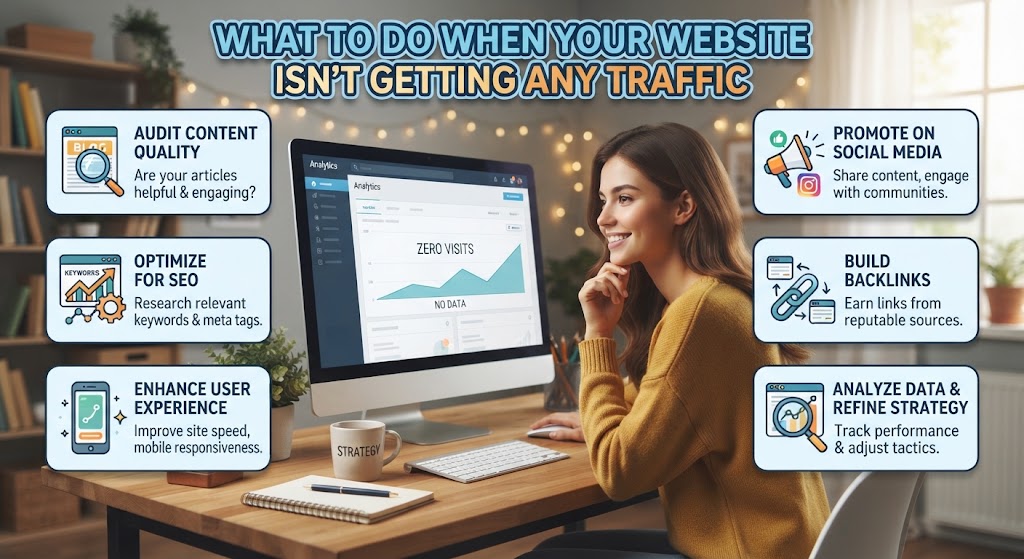
What to Do When Your Website Isn’t Getting Any Traffic
It’s one of the most frustrating situations for any website owner: you’ve built the site, published content, shared it a few times… and still almost no one is visiting. If your website isn’t getting traffic, the problem is rarely just bad luck. In most cases, it comes down to visibility, technical issues, or the lack of a clear growth strategy. Below is a practical 15-point guide to help you diagnose and fix the problem.
Table of Contents
- 1. Check the Basics First
- 2. Content Alone Is Not Enough
- 3. When It Makes Sense to Get Professional Help
- 4. Local & Niche Visibility Also Matters
- 5. Keep Improving Step by Step
- 6. Analyze Your Current Traffic Sources
- 7. Improve Click-Through Rate from Search Results
- 8. Build Topical Authority Instead of Random Posts
- 9. Fix Technical Issues That Block Crawling
- 10. Get Your Brand Mentioned on Other Websites
- 11. Optimize for Local or Niche Visibility
- 12. Use Internal Linking Smartly
- 13. Promote Content Beyond Search Engines
- 14. Track Rankings and Adjust Strategy Monthly
- 15. Know When to Get Professional Help
1. Check the Basics First
Before spending money or time on advanced strategies, make sure the foundation is solid. Is the site mobile-friendly and reasonably fast? Are your important pages indexed by Google? Do you have clear titles, meta descriptions, and helpful content? Many traffic problems start with simple technical or on-page issues that are easy to fix once you identify them.
2. Content Alone Is Not Enough
Good content is important, but it needs distribution and authority signals. Search engines look at many factors beyond the words on the page — including how trustworthy and established your brand appears online. Publishing without promotion rarely delivers strong results.
3. When It Makes Sense to Get Professional Help
If you’ve already published useful content and fixed the basic technical problems but still see very little growth, working with an experienced team can be a smart next step. A good partner can help with technical audits, keyword strategy, content planning, and authority building. Just make sure you choose carefully and look for transparency and realistic expectations.
4. Local & Niche Visibility Also Matters
Sometimes the issue isn’t global rankings but local or niche discovery. Having consistent business information and a proper presence across the web helps both search engines and potential visitors trust your site more. You can see one example of a professional agency listing on this business profile.
5. Keep Improving Step by Step
Traffic growth is usually gradual. Combine consistent helpful content, technical health, smart promotion, and, when needed, professional support. Focus on long-term sustainable growth rather than quick fixes.
6. Analyze Your Current Traffic Sources
Open Google Analytics or any traffic tool you use and check where your existing visitors are coming from. Are they arriving from Google, social media, direct visits, or referral sites? This data shows you which channels have potential and which ones need attention.
7. Improve Click-Through Rate from Search Results
Even if your pages appear on the second or third page of search results, weak titles and meta descriptions can kill clicks. Write clearer, benefit-focused titles and descriptions. A higher click-through rate signals relevance to search engines and can slowly improve rankings.
8. Build Topical Authority Instead of Random Posts
Publishing random articles rarely works long-term. Choose a clear niche or a group of related topics and cover them thoroughly. When search engines see that you consistently publish useful content around the same subjects, they begin to trust your site more.
9. Fix Technical Issues That Block Crawling
Broken links, slow loading speed, poor mobile experience, duplicate content, and incorrect robots.txt settings can stop search engines from properly crawling your pages. A technical audit often reveals hidden problems that silently prevent traffic growth.
10. Get Your Brand Mentioned on Other Websites
Search engines pay attention to brand mentions and links from other sites. Guest posts, helpful contributions, digital PR, and genuine outreach can create valuable signals. Focus on relevant and decent-quality websites rather than low-quality directories.
11. Optimize for Local or Niche Visibility
If your business serves a specific city or industry, general SEO is not enough. Consistent business information, local citations, and niche directory presence can bring more targeted visitors over time.
12. Use Internal Linking Smartly
Many websites publish content but never connect their own pages. Linking related articles together helps both users and search engines understand your content structure. It also helps spread ranking strength across your site.
13. Promote Content Beyond Search Engines
Relying only on Google is risky. Share your best articles on relevant communities, LinkedIn, niche forums, and email lists. Early traffic from other sources can help search engines notice your content faster.
14. Track Rankings and Adjust Strategy Monthly
Check which keywords are slowly moving up and which ones are stuck. Double down on the topics that show progress and improve or update the ones that are not performing. Consistent review and adjustment is essential.
15. Know When to Get Professional Help
If you have already fixed the basics, published consistent content, and still see almost no growth after several months, it may be time to work with experienced people. Reading real customer experiences on platforms like Yelp can help you evaluate agencies more carefully before making a decision.
Final Thoughts
A website with low traffic is usually the result of several small problems rather than one big failure. Fix the technical foundation, create genuinely useful content, build some authority, and promote it consistently. Growth almost always comes from steady improvement rather than overnight miracles.
If you are still in the early stages and looking for simple tools to support your site, you may also find this earlier guide helpful: Free WordPress Plugins Every New Blogger Should Try.